-01.png)


1. How Meta Ads Actually Work Today
Meta ads no longer work the way many advertisers assume they do.
You are not manually targeting people. You are supplying signals to an algorithm that decides who sees your ads, when they see them, and how often.
Those signals come from:
- Your account structure
- Your audiences
- Your creatives
- Your conversion and engagement data
The algorithm rewards consistency, clear signals, and stable decision making. It punishes constant resets, fragmented testing, and shallow optimisation.
This is why two advertisers can use the same tactics and get completely different outcomes. The difference is almost always structural and strategic, not tactical.
Before fixing performance, you need to understand how Meta is interpreting what you are giving it.
2. The Meta Ads Performance Framework
At a high level, Meta ads performance is driven by four interdependent components.
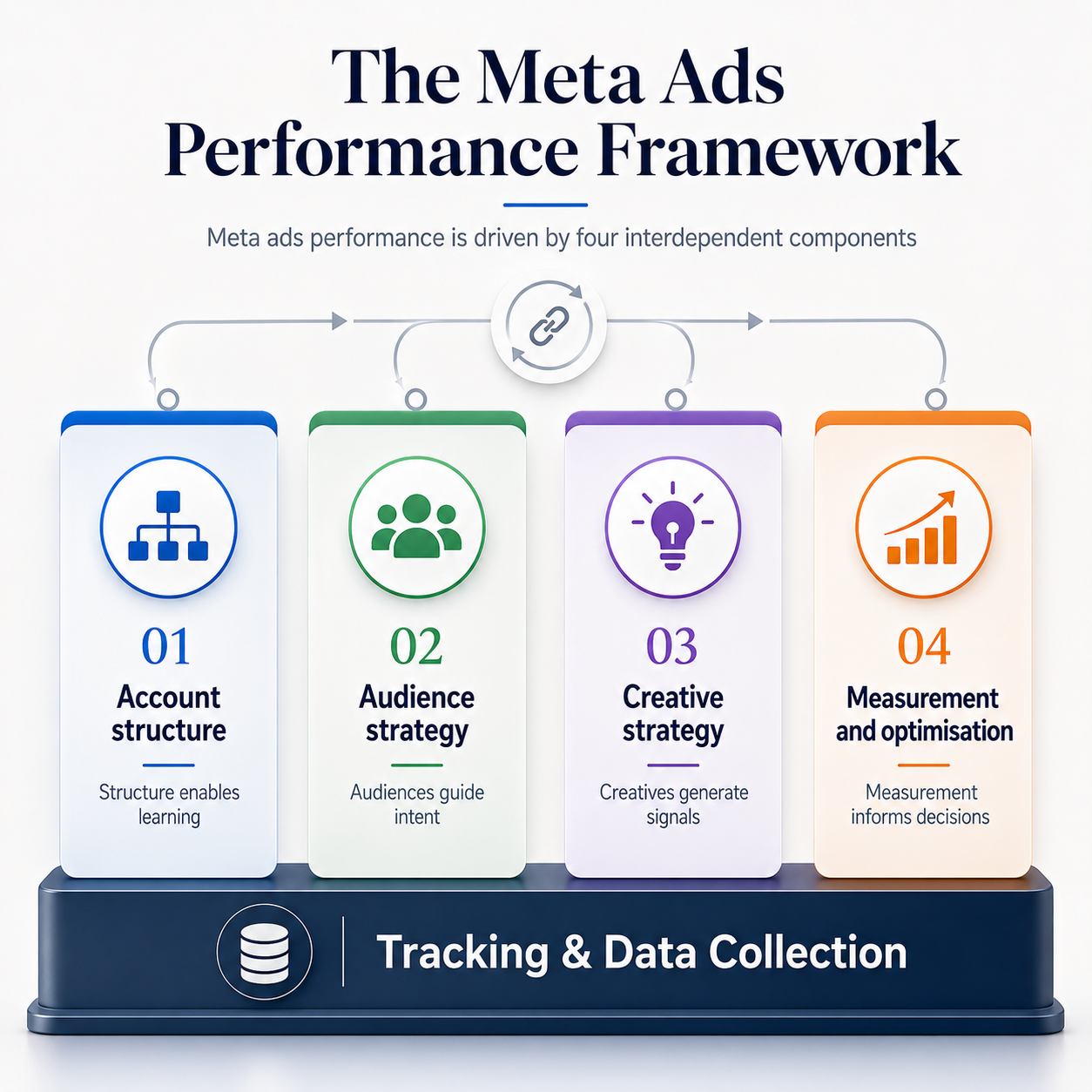
- Account structure- Structure enables learning
- Audience strategy- Audiences guide intent
- Creative strategy- Creatives generate signals
- Measurement and optimisation- Measurement informs decisions
- [All of which are underpinned by tracking and accurate data collection.]
None of these work in isolation. Improving one while neglecting the others rarely produces lasting results.
Think of Meta ads as a system. When performance drops, the goal is not to guess a fix. The goal is to identify which part of the system is underperforming and why.
This framework is the foundation for everything else in this article.
3. Account Structure Is the Foundation
Account structure controls how Meta learns.
Campaigns and ad sets are not just containers. They define how budgets flow, how data is aggregated, and how quickly the algorithm can find stable patterns.
Common structural problems include
- Too many ad sets competing for the same budget
- Over-segmentation that starves learning
- Constant duplication that resets data
A good structure does three things
- Concentrates data instead of fragmenting it
- Matches business goals to optimisation goals
- Makes performance easy to interpret
When structure is wrong, even strong creatives and audiences struggle to perform consistently.
Read more about Meta Ads Account Structure in my article here.
4. Audience Strategy Is About Signal Quality
Audience targeting today is less about control and more about guidance.
Broad targeting works when your creatives clearly communicate who the product is for. Narrow targeting works when signals are weak and Meta needs help narrowing intent.
The biggest mistake advertisers make is treating audiences as the main performance driver. In reality, audiences amplify or dampen the signals created by creatives.
Strong audience strategy
- Starts with a clear understanding of the customer
- Translates that understanding into algorithm friendly signals
- Audiences needs are spoken to via targeted messages and creatives
- Evolves as data improves
When audiences fail, it is often because you are not reaching the right audiences with the right content. Learn more about a structured way to build prospecting audiences and achieve a stronger audience-content fit here: Audience Targeting on Meta: How to Digitise Your Customer Personas.
5. Creatives Are the Primary Performance Lever
Creatives are the strongest signal you control.
They influence
- Delivery
- Click through rate
- Conversion rate
- Learning stability
Most Meta ads accounts do not fail because of bidding or targeting. They fail because the message is unclear, repetitive, or misaligned with user intent.
Effective creative strategy focuses on
- Clear problem awareness and strong value communication
- Systematic A/B testing of variables
Creative fatigue is often misdiagnosed. In many cases, it is message fatigue, not frequency, that causes performance to drop. For a structured approach and exact levers to pull, check out my Meta Ads Creative Testing Playbook: A Step by Step Method.
6. Reading Meta Ads Data the right way- A funnel approach to ad optimisation
Meta ads performance should be read as a flow, not a dashboard.
Each stage influences the next.
Delivery issues often originate from weak creatives or improper targeting.
Click issues often originate from unclear positioning and inappropriate audience-content fit.
Conversion issues often originate from mismatched expectations or landing experience.
Looking at metrics in isolation leads to reactive decisions. Reading the funnel as a sequence allows you to diagnose root causes instead of symptoms.
The goal is not to optimise every metric. The goal is to identify the weakest link that is limiting the entire system.
7. Tracking and Data Accuracy — The Backbone of Measurement
Underpinning every effective performance marketer is proper tracking and data accuracy. Here’s the unsexy part of Performance Marketing: Tracking Pixels and UTMs — and Why They're Non-Negotiable.
Tracking pixels and UTMs are the unsung heroes of Meta ads. Without proper tracking, performance analysis is incomplete and potentially misleading. Even the best account structure, audiences, creatives, and optimisation cannot compensate for inaccurate data.
Here's how it fits into the framework:
- Pixels: The Core Data Source
- The Meta Pixel is a key tool for tracking user actions on your website. It’s responsible for providing conversion data, enabling you to optimise campaigns toward the most valuable actions (purchases, sign-ups, etc.).
- Proper pixel installation across the entire website ensures that Meta can accurately track customer behaviour and feed the algorithm with the right signals. Inaccurate or incomplete pixel setup can lead to poor performance due to incorrect learning signals.
- The Meta Pixel is a key tool for tracking user actions on your website. It’s responsible for providing conversion data, enabling you to optimise campaigns toward the most valuable actions (purchases, sign-ups, etc.).
- UTMs: Tracking Campaign Performance Across the Funnel
- UTMs (Urchin Tracking Modules) allow you to track the source, medium, and campaign name across different channels. With UTMs in place, you can get granular insights into how users interact with your ad after they click, especially when integrated with Google Analytics and your CRM.
- By tagging your Meta ad links with UTMs, you ensure that you are capturing campaign-level data, making it easier to evaluate performance across the entire funnel (click → landing page → conversion).
- UTMs (Urchin Tracking Modules) allow you to track the source, medium, and campaign name across different channels. With UTMs in place, you can get granular insights into how users interact with your ad after they click, especially when integrated with Google Analytics and your CRM.
If you haven’t done this crucial foundation step, you are essentially bleeding ad dollars. Fix it quickly and easily with my step-by-step guide: Before You Spend A Cent On Meta Ads- How to Properly Track and Measure Meta Ads: Pixels, UTMs and Conversions
Conclusion: Meta Ads Is a Skill, Not a Channel
Meta ads success is not about finding the perfect tactic. It is about building decision making skills within a clear framework.
When you understand how structure, audiences, creatives, and measurement interact, performance becomes more predictable and scalable.
This framework is not static. It evolves with the platform, but the thinking behind it remains constant.
If you want to master Meta ads rather than chase updates, start by mastering the system.