-01.png)


Part 1: Understanding the Match Type Landscape in 2026
Before we dive into the specifics of keyword strategy, it's important to clarify how match types work today and how they can still be leveraged effectively.
The Role of Match Types
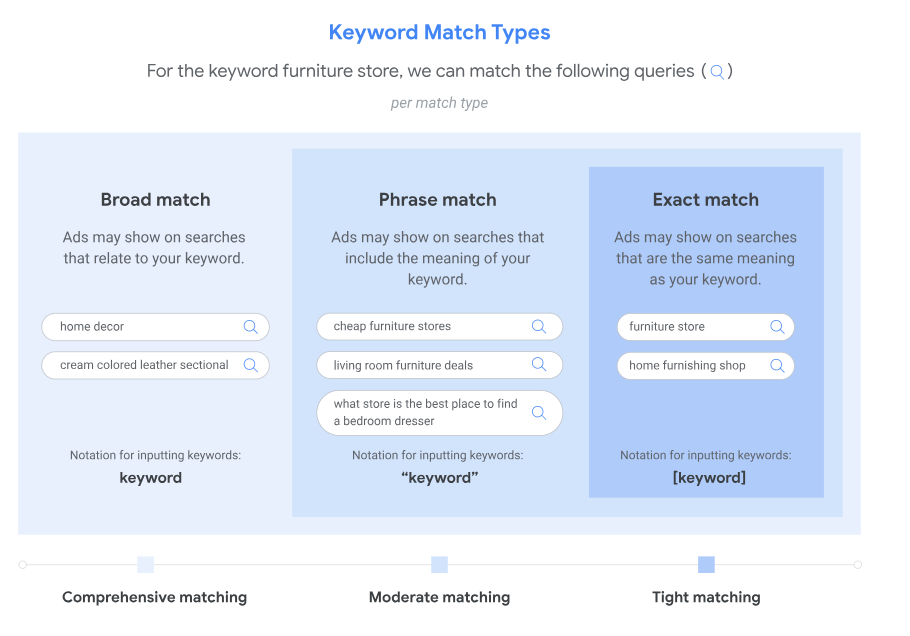
Match types still serve a useful purpose, but they function more as a scaling tool than a strict control mechanism. Here’s a breakdown of how they work in 2026:
- Exact match: This is still the most controlled match type, but it’s no longer about strict wording. Exact match now refers to keywords that closely align with the meaning and intent of what the searcher is looking for.
- Phrase match: Phrase match provides a middle ground between exact match and broad match. It allows for controlled expansion, enabling you to target related terms while keeping the core meaning intact.
- Broad match: Broad match has become much smarter, leveraging Google’s machine learning to show ads for terms that are contextually related to your keyword. However, this requires careful use and good conversion tracking, as broad match can expand your reach too far if not managed properly.
What’s changed in 2026?
- Exact match no longer means literal matches: Google’s algorithm now interprets intent rather than just matching the exact characters. This means the definition of “exact match” has broadened.
- Broad match modifier is no longer available: Google has phased out broad match modifier, meaning advertisers can no longer target broad keywords with a modifier like “+keyword” to narrow the scope.
- No opt-out for close variants: Close variants are now automatically included for all match types. This means your keywords may match variations of your search terms, including plural forms and synonyms, even if you haven’t specified them.
Part 2: Building a Keyword Strategy for Clients in 2026
Step 1: Start with the Client’s Buying Language
Before you even start looking at keyword tools, it’s important to understand the client’s business, their customers, and their language. Get clarity on the following aspects:
- Core services or products: What are the client’s main offerings that bring in the most revenue?
- Ideal customers: Who are their best customers? What do they look like, and how do they make buying decisions?
- Service boundaries: Are there any services the client does not offer? Understanding this can help prevent wasting spend on irrelevant searches.
- Location served: Does the client serve local, national, or global markets? Location-based targeting can be a key differentiator.
- Budget constraints: What is the average budget range/ cost per conversion that the client accepts? This helps in determining the level of competition they’ll face for certain keywords.
- Objections and barriers: What are the common objections that prospects have before buying? For example:
- Cost Concerns – "Is this worth the price? Are there cheaper alternatives?"
- Time Commitment – "I don’t have enough time to invest in this."
- Uncertainty About Value – "How will this actually benefit me? What value does it bring?"
- Fear of Not Succeeding – "What if I don’t succeed with this product or service?"
- Relevance to My Needs – "How relevant is this to my specific situation?"
- Trust and Credibility – "How can I trust that this is legitimate or effective?"
- Overwhelmed by Choices – "There are too many options, and I don’t know which one to choose."
By aligning your keywords with the client’s actual buying language and addressing their customer pain points, you ensure that your strategy is grounded in real customer behavior, not just theoretical terms.
Step 2: Create an Intent Map for Your Keywords
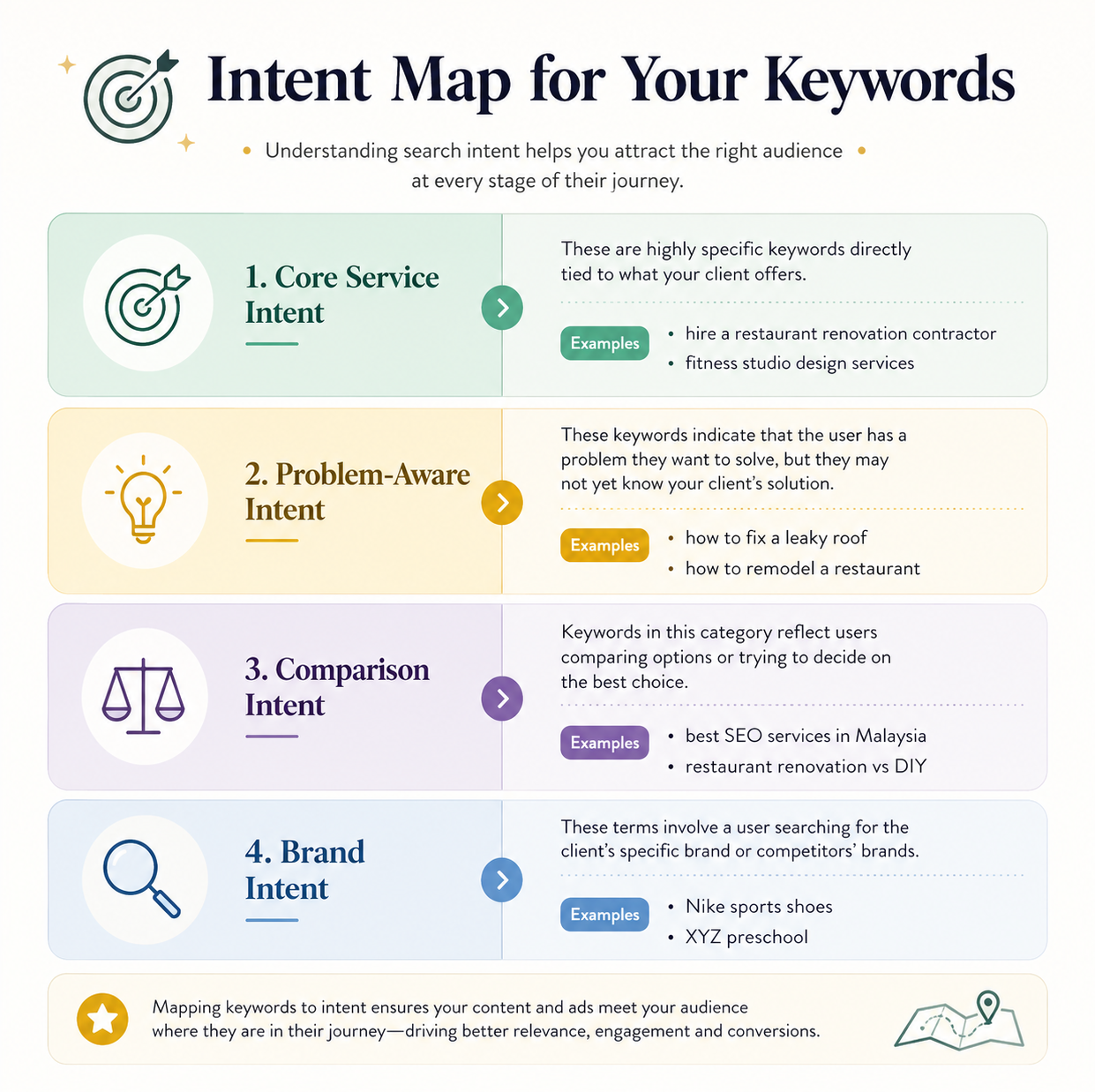
Keywords are not just a random list of terms. They should reflect the different stages of the buyer’s journey and their intent. Here’s a breakdown of the five common intent categories:
- Core service intent: These are highly specific keywords directly tied to what your client offers. For example, “hire a restaurant renovation contractor” or “fitness studio design services.”
- Problem-aware intent: These keywords indicate that the user has a problem they want to solve, but they may not yet know your client’s solution. Examples include “how to fix a leaky roof” or “how to remodel a restaurant.”
- Comparison intent: Keywords in this category reflect users comparing options or trying to decide on the best choice. Examples include “best SEO services in Malaysia” or “restaurant renovation vs DIY.”
- Brand intent: These terms involve a user searching for the client’s specific brand or competitors’ brands. For instance, “Nike sports shoes” or “XYZ preschool.”
- Research intent: Users with this intent are gathering information but may not yet be ready to make a purchase. Examples are “what is pay per click” or “how to start an online business.”
By identifying which intent buckets your client’s target customers fit into, you can ensure that your keyword strategy addresses each stage of the buyer’s journey.
Step 3: Structure Keywords Based on Intent
Now that you have your intent map, it’s time to create a keyword structure that matches your client’s offers and audience. For this stage, you are creating categories to research deeper into (more on choosing the right keywords later).
A well-organized keyword structure is crucial for maximizing relevance and ensuring that your ads align with user intent. It helps you create clear paths for optimization, making it easier to manage budgets, improve bidding efficiency, and ensure that your ad copy and landing pages are directly relevant to each user’s search. By grouping related keywords, you can refine targeting, minimize waste, and ultimately increase your chances of converting clicks into valuable actions.
Here are a few tips for creating your keyword structure effectively:
1) Separate by Keyword Type (Brand, Competitor, Unbranded)
Why? Different keyword types (brand, competitor, unbranded) require distinct strategies for bidding, targeting, and messaging.
- Brand keywords (specific to your business):
- Goal: Low CPC, higher conversion rates, and brand awareness.
- Goal: Low CPC, higher conversion rates, and brand awareness.
- Competitor keywords (targeting competitors brand names):
- Goal: More aggressive bidding, capturing competitor’s audience.
- Goal: More aggressive bidding, capturing competitor’s audience.
- Unbranded keywords (general keywords without brand names):
- Example keywords:
- “kitchen renovation contractor”
- “digital marketing agency”
- “electric vehicle options”
- “kitchen renovation contractor”
- Goal: Higher volume but more competition.
- Example keywords:
As the universe of unbranded keywords is very big, that’s where most of the structuring comes in:
2) Separate unbranded keywords by Service or Product Offerings
Why? Different services/products may require different messaging, landing pages, and ad targeting.
Example structure:
- Campaign 1: Home Renovation Services:
- Adgroup 1: kitchen renovation keywords
- Adgroup 2: bathroom renovation keywords
- Adgroup 1: kitchen renovation keywords
- Campaign 2: Interior Design Services:
- Adgroup 1: Residential interior designer
- Adgroup 2: Commercial space interior designer
+ Negative keywords related to home renovation services in this campaign to make sure campaign 2 doesn’t overlap with campaign 1.
3) Separate by Target Audience
Why? Different audience segments may have distinct needs, budgets, and behaviors that require tailored messaging and bidding strategies.
Example structure:
- Campaign 1: Small Business Clients
- Adgroup 1: Targeting small businesses e.g. “Affordable SEO services for small businesses” / “Local SEO services for small businesses”
- Adgroup 2: Targeting startups e.g. “PPC management for startups”
- Adgroup 1: Targeting small businesses e.g. “Affordable SEO services for small businesses” / “Local SEO services for small businesses”
- Campaign 2: Enterprise Clients
- Negative keywords related to small business terms in the enterprise campaign to prevent overlap and maintain focus.
4) Separate by Geography or Location
Why? Keywords targeted by location often require different strategies due to local competition, demand, and cultural relevance. CPC usually varies largely by countries as well.
Example structure:
- Campaign 1: Kuala Lumpur-Based Services
- E.g. “Plumbing services KL”
- E.g. “Plumbing services KL”
- Campaign 2: Penang- Based Services
- E.g. “Plumbing services Penang”
5) Separate by Buyer Intent (Transactional vs. Informational)
Why? Transactional and informational keywords require different approaches in messaging and landing page content, as they reflect different stages of the buyer’s journey.
Example structure:
- Campaign 1: Transactional Keywords (Ready to Buy)
- E.g. “Buy leather jackets online” / “Order custom leather jackets”
- These keywords should land on the product landing pages as users are geared towards purchases
- Campaign 2: Informational Keywords (Research Phase)
- Adgroup 1: How-to E.g. “How to choose a leather jacket”
- These keywords can land on the informational pages (such as articles/ blogs) to nurture and convince these users of your products which can be linked in your blog.
- Adgroup 2: “Best leather jacket dealer”
- Adgroup 1: How-to E.g. “How to choose a leather jacket”
Part 3: How to Choose the Right Keywords
Choosing the right keywords is more than just finding terms with high search volume. You need to balance volume with intent, competition, and the client’s budget. Here’s how to choose keywords for your client:
1) Intent Quality
The first step is to evaluate the intent behind each keyword. Ask yourself:
- Is this keyword directly related to the client’s services?
- Does it reflect a high or low likelihood of conversion?
High-intent keywords (like “buy PPC course” or “hire restaurant renovation contractor”) should always be prioritized. These are keywords that indicate the user is further down the buyer’s journey and more likely to convert. Only if there is additional budget and desire for scale, should you invest in lower- intent keywords.
2) Search Volume
Search volume is an important factor, but it shouldn’t be the only consideration. A keyword with a large search volume may have too broad of an intent and lead to wasted spend if it’s not tightly aligned with the client’s business.
Here are the guidelines for selecting keywords based on search volume:
- Under 10 searches per month: These keywords are often too small to be valuable, unless they’re extremely high intent.
- 10 to 50 searches per month: These are often ideal for niche markets, especially if the client is in a highly specialized industry.
- 50 to 300 searches per month: These are good keywords for local businesses or specialized services.
- 300+ searches per month: Be careful with broad keywords, as they may attract irrelevant traffic. Consider segmenting these into specific ad groups.
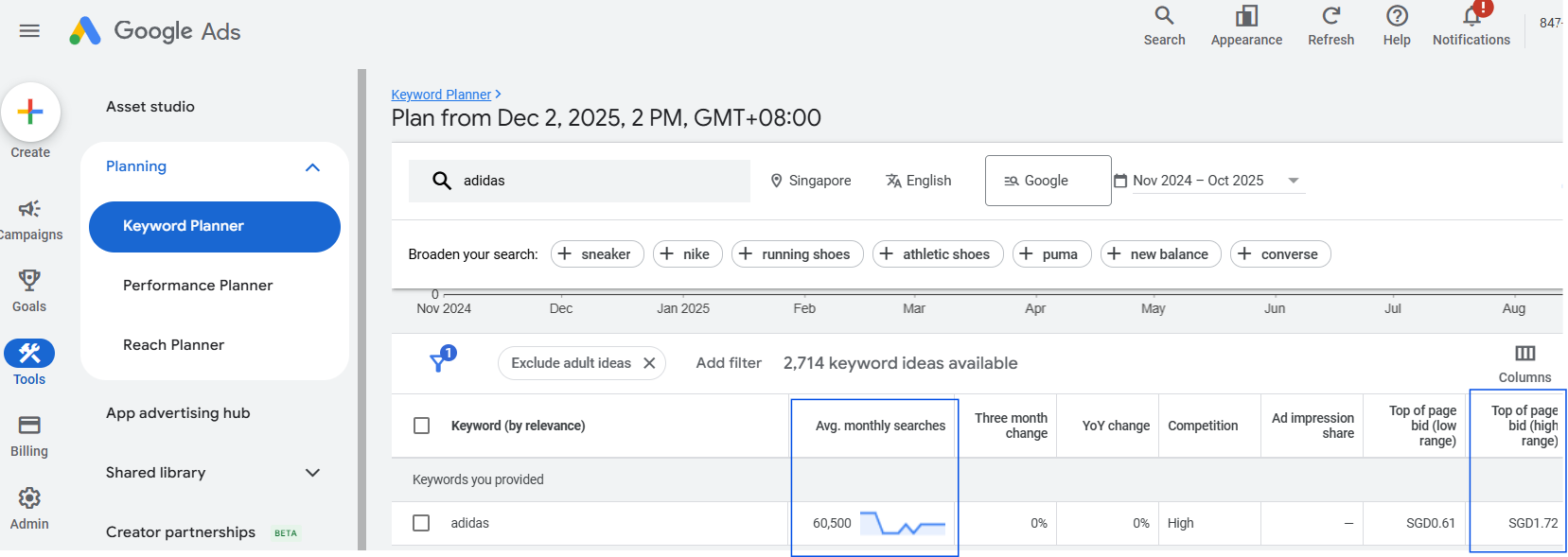
You can use keyword research tools such as SEMRush or even Google’s own Keyword Planner to get search volume data.
3) Client Economics
The client’s business model and budget should influence your keyword choices. If the client has a high customer lifetime value (CLTV), you can afford to bid higher on competitive keywords. But if their margin is thin, you’ll need to be more selective with your keyword choices.
Make sure the cost per acquisition (CPA) aligns with the client’s expected revenue per lead or sale. This will help ensure that your keyword strategy is financially viable.
In order to track the keyword level cost per acquisition, you must have proper web analytics and online store tracking set up. Check out my guide on proper Google Ads tracking here: Before You Spend A Cent On Google Ads-How To Set Up Tracking With GA4 And Your Online Store Properly
4) Feasibility and Competition
Check the competition for your target keywords. If the keywords are highly competitive, it might be harder to achieve a positive return on investment (ROI) unless the client has a strong brand or high-quality landing pages.
If a keyword is too competitive, consider using more niche or long-tail variations. For example, instead of bidding on “restaurant renovation,” you might bid on “affordable restaurant renovation contractors in Kuala Lumpur.”
You can use keyword research tools such as SEMRush or even Google’s own Keyword Planner to get competition levels. If not available, look at the estimated CPC as a higher CPC keyword means that there is stronger competition for that keyword.
5) Landing Page Relevance
Every keyword should map directly to a relevant landing page that fulfills the promise implied by the keyword. If the keyword refers to a specific service, the landing page must clearly explain that service and guide the user toward conversion. If the landing page is irrelevant, even the best keyword strategy will fail.
Part 4: Negative Keywords and Guardrails
Negative keywords are essential to prevent your ads from showing for irrelevant searches. You should add negatives at the start and continuously update them based on search term reports.
Here are three categories of negative keywords:
- Universal waste negatives: These are terms that are typically irrelevant for almost any client, such as “free,” “jobs,” “internships,” or “torrent.”
- Client-specific negatives: These are terms that may apply to specific clients, such as “residential,” “DIY,” or “template” for clients offering commercial services.
- Brand negatives for your unbranded campaigns: Exclude your brand terms from your unbranded campaigns so that they don’t overlap with your brand campaigns and give an overly optimistic conversion rate.
For more ways to optimise your campaigns apart from negative keywords, check out my guide: How To Analyse Google Search And Shopping Data- Why Pay per Click Campaigns Need to Be Analyzed Differently From Pay per Impression
By following this more detailed, structured approach to keyword strategy, you’ll be able to create campaigns that are not only more efficient but also more aligned with your clients' goals. With a focus on intent, clear structure, and careful keyword selection, you can scale campaigns successfully and ensure they deliver long-term value.